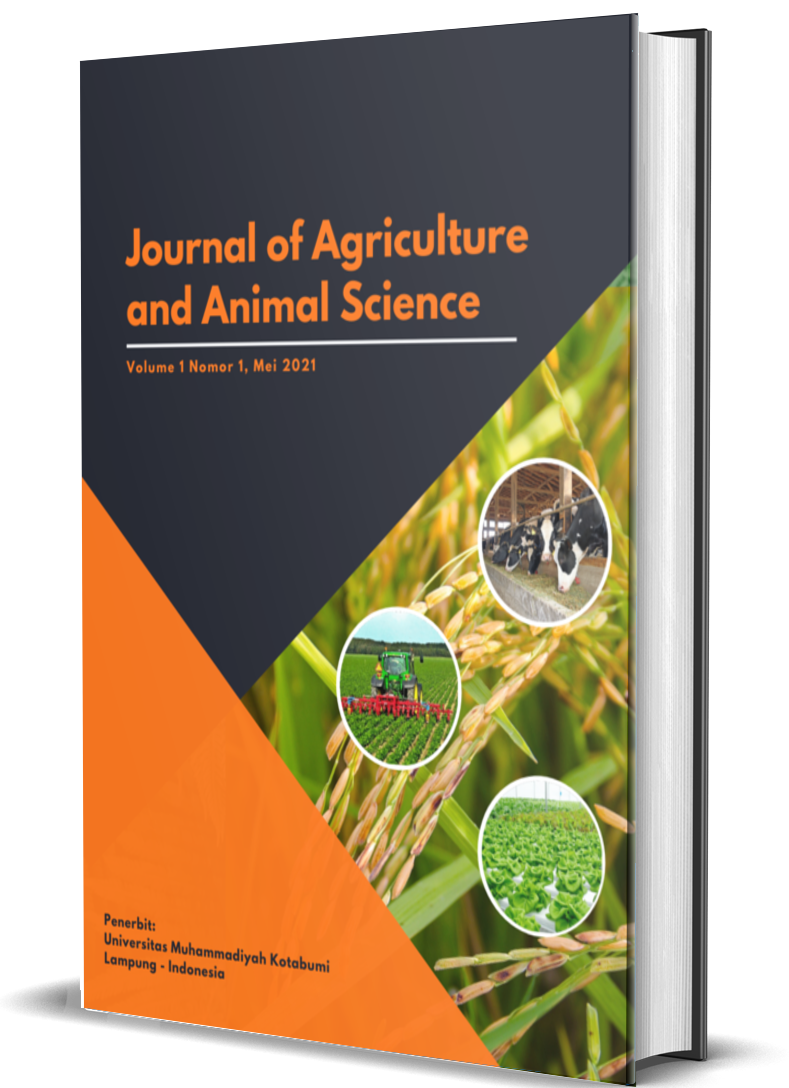
Journal of Agriculture and Animal Science

Journal of Agriculture and Animal Science (P-ISSN 2829-6419 | E-ISSN 2808-6481) is online journal system published by Universitas Muhammadiyah Kotabumi. Journal of Agriculture and Animal Science publishes the results of research and original reviews related to the biosciences, biotechnology, and biological resources in the fields of agriculture and animals science. Journal of Agriculture and Animal Science covers a variety of research topics : Agriculture includes crop cultivation and engineering,... Readmore

Journal of Agriculture and Animal Science (P-ISSN 2829-6419 | E-ISSN 2808-6481) is online journal system published by Universitas Muhammadiyah Kotabumi. Journal of Agriculture and Animal Science publishes the results of research and original reviews related to the biosciences, biotechnology, and biological resources in the fields of agriculture and animals science. Journal of Agriculture and Animal Science covers a variety of research topics : Agriculture includes crop cultivation and engineering, plant breeding and biotechnology, crop and land management technology, agricultural ecosystems, exploration of fertilizers and pesticides, plant pests, all agricultural agribusiness activities (the manufacture and distributi... Readmore

ISSN
2829-6419 (printed) | 2808-6481 (online)
Published
2025-10-01
Accreditation
sinta-4

Articles

Peran Praktek Agroforestri Kopi terhadap Iklim Mikro dan Sifat Fisik Tanah di Desa Lanjan Jawa Tengah

The increase in the earth's temperature causes extreme climate change which affects the microclimate around plants. Practice of agroforestry is increasingly recognized as an effective land management system that integrates forestry species with agricultural crops to enhance ecological and economic functions. This study focuses on evaluating the role of coffee-based agroforestry practices on microclimate elements and soil physical properties in Lanjan Village, Central Java. The research is driven by the need to understand how shade trees in agroforestry systems influence environmental conditions and support sustainable agriculture, particularly in coffee cultivation. A field-based experimental approach was employed, involving observations and measurements of microclimatic parameters (temperature and humidity) and soil physical characteristics (bulk density). The formulated hypothesis posits that agroforestry practices significantly alter the microclimate and physical characteristics of the soil. The findings confirm that agroforestry has a substantial impact on shaping key microclimatic elements, notably by reducing ambient air temperature and increasing air humidity under tree shade. Additionally, the system exhibits a statistically significant influence on bulk density, indicating an improvement in soil structure and potential for enhanced fertility. Overall, the research highlights that agroforestry systems not only support crop productivity but also contribute positively to microclimate regulation and soil physical health. These insights underscore the importance of integrating shadeas a sustainable land management strategy, particularly in regions experiencing climate variability and soil degradation.

Pandangan Ekonomi Dan Kesadaran Lingkungan Petani Terhadap Penggunaan Varietas Padi MSP Di Kecamatan Kotabumi Utara

Rice farming has received significant attention from the government, which aims to increase production. Problems that often occur in agriculture, especially rice farming, are unstable production and price uncertainty during the harvest season. Efforts have been made to minimize negative impacts economically and environmentally. One of the efforts made is by using MSP (Let's Prosper Farmers) rice varieties that have been certified as superior varieties. Economic perspectives and environmental awareness are important parts of agricultural sustainability. Sustainable agriculture, in addition to being profit-oriented, must also maintain the condition of the surrounding environment. North Kotabumi District is an area that has used the MSP rice variety. This study is expected to provide input and contribution to formulating appropriate strategies and policies to create a sustainable rice farming system, which is not only economically profitable but also environmentally friendly. The study was conducted in Talang Jali, Madukoro, and Wonomarto Villages in North Kotabumi District, North Lampung Regency. A total of 32 farmers became research respondents. The data collection technique used an interview technique using a Likert scale. Data analysis used qualitative descriptive. As many as 53.12% of farmers have a moderate category towards economic views in the use of MSP rice varieties. Farmers' environmental awareness is included in the high category with 59.37% of farmers having a positive perception of the environment.

Faktor Produksi Minyak Kelapa pada Industri Rumah Tangga di Desa Mekkatta Selatan, Majene

Indonesia is known as one of the countries with very abundant biodiversity, such as coconut users with a myriad of significant health benefits and applications. One of the most common processed coconut products is coconut oil. Coconut oil as one of the products of the home industry, has great potential in South Mekkatta Village, Majene Regency. Various factors can affect coconut oil production, ranging from internal factors such as the quality of raw materials and labor skills to external factors. This study aims to analyze the influence of factors affecting coconut oil production in the household industry in South Mekkatta Village, Malunda District, Majene Regency. This type of research is quantitative research. The method of determining the research sample using Simple Random Sampling, with a sample size of 39 people. The data analysis technique used is multiple linear regression analysis. The results showed that the amount of raw materials had a significant effect on coconut oil production, while labor, fermentation time, and production costs had no significant effect on coconut oil production.

Effects of Using Cassava Leaf Powder on Quail Growth Performance at National University of Cheasim Kamchaymear, Cambodia

Quail are a popular domestic breed, easy to raise, fast-growing, and prolific egg producers. They also exhibit high resistance to diseases. Feed is a crucial factor in animal husbandry; utilizing high-value feed directly correlates with lower profits. This study aims to evaluate the effect of cassava leaf powder as a feed on the quail's growth performance. This experiment was conducted at Thnalkaeng village, Smaongcheung commune, Kamchaymear district, Prey Veng province. For this study's methods, 180 healthy 4-day-old quails, with an average weight of 10.20 grams, were selected and randomly assigned to four treatments (T0, T1, T2, and T3). Each treatment comprised three replicates, with 15 quail per replicate, following a completely randomized design (CRD) experimental model. Treatment T0 received 100% compound feed (control). Treatment T1 received 5% cassava leaf powder and 95% compound feed. Treatment T2 received 10% cassava leaf powder and 90% compound feed. Treatment T3 received 15% meat meal and 85% compound feed. In this experiment, all quails were weighed at the beginning and then weekly from the first to the sixth week. The results showed no statistically significant difference (P > 0.05) in the average daily feed intake among the quail. However, the intake of quails in treatment T2 (15.76 g) was higher. The average starting weight of all quails was similar (P>0.05). A statistically significant difference (P<0.05) was observed in the average daily weight gain during the first week. Conversely, the daily weight gain from the second to the sixth week did not differ significantly (P>0.05) among the quail. The average daily weight gain was highest in quails from treatment T1 (3.64 g), which were fed cassava leaf powder at a 5% level. No significant difference (P>0.05) was found in the average feed conversion ratio (FCR) among the quail. Quails in treatment T1 exhibited the lowest feed conversion ratio (4.48 g). Based on the results of this study, it can be concluded that adding cassava leaf powder to the feed does not positively affect daily feed intake or the feed conversion ratio. However, using cassava leaf powder at a 5% level does have a positive effect on weight gain.

Kajian Analisis Pengendalian Tikus Sawah (Rattus argentiventer) pada Tanaman Padi

Rice cultivation faces several challenges, including attacks by plant pests (OPT). The rice rat (Rattus argentiventer) is a pest that attacks rice plants, both in lowland and upland rice fields. Rice rats cause damage and losses of up to 80% both before and after harvest and negatively impact food security. The aim of this study was to determine the most effective method for controlling rice rats (Rattus argentiventer). The research method employed a qualitative approach, utilizing secondary data on rat populations and control methods in Indonesia from 2020 to 2024. Data analysis was descriptive and presented in tables and figures. The number of catches using the gropyokan method varies significantly depending on several factors, including area size, rat population levels, the number of farmers involved, and the duration of the gropyokan. This variation is demonstrated by the data. For example, there were 534 rats in a 50-hectare area in Batubara, and thousands (3,500) in Sragen could be reached within three hours of operation in some locations, and nearly 6,000 rats in others. Rat control using the rice-fish method improves land use efficiency and also helps control plant pests, particularly rice field rats. Rat control using the rice-fish method improves land use efficiency and also helps control plant pests, particularly rice field rats. Using rat traps is also an effective and environmentally friendly control method. Traps capture rats, both live and dead, without leaving chemicals in the environment. Controlling rats using fumigation is much safer than other methods of rodent control.

Kajian Parameter Genetik Asal Bahan Tanam Stek Lada Natar-1 Serta Implikasi Terhadap Program Pemuliaan Tanaman

Black pepper (Piper nigrum) is a spice crop with significant potential as an export commodity. In Indonesia, Lampung Province is one of the major production centers contributing to national pepper production after the Bangka Belitung Islands. However, the export potential of black pepper is not aligned with its actual production levels. Strategies to enhance pepper production include the introduction of superior cultivars, such as the Natar 1 variety and vegetative propagation using cuttings sourced from both climbing and fruiting shoots. This study aims to evaluate genetic parameters and the effect of different sources of planting material of the Natar 1, as well as their implications for plant breeding programs. The experimental treatment used a single-case experimental design with three replications, while the experimental layout followed a completely randomized design. The highest genetic variability was observed in the traits of shoot height, number of shoots, number of nodes, and number of roots. Phenotypic variability showed a range of values, categorized as low, moderate, and high. High heritability was recorded for root fresh weight, and planting materials derived from climbing shoots produced higher average values compared to those from fruiting shoots. Estimates of the genotypic and phenotypic coefficient of variability, heritability is important information for plant breeders and have implications for breeding programs, particularly in variety purification and the selection of superior clones. Such information is useful for identifying which plant parts are most effective for propagation, enabling breeders to efficiently multiply superior genotypes and accelerate the development of new varieties.

Pengaruh Penambahan L-Arginin terhadap Total Spermatozoa Motil (TSM) pada Semen Beku Kambing Boer

One important factor determining this quality is the dilution process, which aims to maintain sperm motility and viability during the freezing process. Low storage temperatures can causecold shock, namely damage to the plasma membrane of cells which can cause the death of spermatozoa.This study aims to evaluateThe effect of adding L-Arginine on total motile spermatozoa (TSM)in frozen Boer goat semen. The fresh semen used had a minimum individual motility of 80% and a mass motility of ++. The diluent used was Tris-aminomethane egg yolk, with varying concentrations of L-Arginine.Fresh semen is evaluated macroscopically based oncolor, odor, volume, consistency, and pH, then continued with observation of total motile spermatozoa after the freezing process to assess the effect of adding L-Arginine.This research usesCompletely Randomized Design (RAL)with 4 treatments and 10 replications, namely:P0: 0 mM L-Arginine (control), P1: 5 mM L-Arginine, P2: 6 mM L-Arginine P3: 7 mM L-Arginine. The results of this study: The average percentage of Total Motile Spermatozoa (TSM) after freezing is:P2 (6 mM): 28,25 ± 2,38%, P0 (0mM): 25,00 ± 2,38%, P3 (7 mM): 24,15 ± 2,38%, P1 (5 mM): 23,20 ± 2,62%. Addition L-Arginine 6 mM (P2) provided the best results in increasing the total percentage of motile spermatozoa after freezing. Thus, a concentration of 6 mM L-Arginine can be recommended as the optimal.

Respons Pakcoy (Brassica rapa) Akibat Teknik Pemupukan Terhadap Karakter Fisiologis dan Hasil Panen

Proper cultivation techniques will increase Brassica rapa plant production. One alternative to increase Brassica rapa plant production is through fertilization techniques. This experiment aims to obtain the best fertilization technique to improve the physiological characteristics and harvest yield of Brassica rapa plants. This experiment uses a one-factor Complete Randomized Block Design (RCBD) method. The treatment factors used were the dip fertilization technique, the row fertilization technique, the drip fertilization technique, and the spread fertilization technique. The research stages carried out include preparation of planting media, preparation of seeds, planting, fertilizer application, maintenance and harvesting, followed by observation and data analysis. The parameters observed were leaf area, dry weight, leaf area index, net assimilation rate, plant growth rate, yield per plot and marketability. The data that has been collected is then analyzed with an alpha of 5% and if there is a significant difference it is further tested with BNT (Least Significant Difference) at an alpha of 5%. The drip fertilization technique did not have a significant effect on leaf area, dry weight, leaf area index, net assimilation rate and plant growth rate but had an effect on yield per plot and marketability. The best fertilization technique was the drip treatment.

Pengembangan Sistem Integrasi Sapi Pedaging dan Kelapa Sawit Terhadap Pemberdayaan Sumber Daya Manusia di Desa Hanakau Jaya

The integration of beef cattle and oil palm is an agricultural model that combines oil palm cultivation and livestock production in one land area. This research was conducted at Hanakau Jaya, Sungkai Utara District. This study proposed to formulating a development strategy for an integrated system of beef cattle and oil palm to empower people in Hanaka Jaya. Data collection was held from 29 April to 5 May. Data collection using qualitative methods in-depth interviews, focus group discussions and questionnaires. Results showed that first, the IFE matrix shows a score 2,534 and the EFE matrix gets a score of 2,855. Second, Based on the IE matrix  development of an integrated system for beef cattle and oil palm is in quadrant V which shows the conditions to be hold and maintain. Third, There are several efforts for the development of a beef cattle and palm oil integration system for human empowerment in Hanakau Jaya Village based on the priority of the SWOT matrix analysis such as: a) Open a competent recruitment in the field of animal husbandry as an effort to develop sustainable integration. b) Develop cooperation with the government as an effort to get ease to get capital, farmer training and market both domestically and internationally. c) Improving the health of cows through vaccination efforts, maintaining nutrition in feed, health monitoring and establishing cooperation with medical experts. d) Optimize risk management through the development of mitigation strategies.

Efektivitas Herbisida Bahan Aktif Haloxyfop-R Methyl Ester Terhadap Gulma Belulang (Eleusine Indica L.)

Penelitian ini bertujuan untuk mengetahui respon gulma belulang (Eleusine indica L.) terhadap berbagai dosis bahan aktif Haloxyfop-R Methyl Ester serta menentukan dosis yang paling efektif dalam pengendaliannya. Penelitian dilaksanakan di Desa Bangun Sari, Kecamatan Abung Surakarta, Kabupaten Lampung Utara. Menggunakan Rancangan Acak Lengkap (RAL) dengan lima perlakuan dan empat ulangan. Perlakuan terdiri dari H0 kontrol (tanpa herbisida), serta empat dosis Haloxyfop-R Methyl Ester H1 1 ml, H2 1,8 ml, H3 2,6 ml, dan H4 3,4 ml per 500 ml air. Parameter yang diamati meliputi tinggi Eleusine indica L., jumlah cabang, tingkat keracunan gulma (visual skoring), dan bobot kering Eleusine indica L.. Hasil penelitian menunjukkan bahwa herbisida Haloxyfop-R Methyl Ester berpengaruh nyata terhadap semua parameter pengamatan. Perlakuan H2 (1,8 ml/500 ml air) memberikan hasil terbaik, dengan jumlah cabang terendah (0,5), tingkat keracunan tertinggi (skor 1 pada 15 HSA), dan bobot kering terendah (5,29 g). Berdasarkan hasil tersebut, dapat disimpulkan bahwa dosis H2 paling efektif dalam menekan pertumbuhan dan perkembangan gulma Eleusine indica L. Dosis ini dinilai optimal karena mampu memberikan pengendalian maksimal dengan penggunaan bahan aktif yang efisien, serta berpotensi lebih ramah lingkungan dibandingkan dosis yang lebih tinggi. Kata kunci: Haloxyfop-R Methyl Ester, Eleusine indica L., dosis herbisida, keracunan visual, bobot kering

Pengaruh Pemberian NaCl Terhadap Produksi Caisim (Brassica Juncea L) di Tulang Bawang Barat

The production of caisim plants in Tulang Bawang Barat District is still not optimal. One of the contributing factors is the inadequate use of fertilizers. The right fertilizer can enhance both the quality and quantity of plant production. One type of fertilizer frequently used by farmers is NaCl. To ensure optimal production and quality of the plants, appropriate application of NaCl is needed to avoid detrimental effects. This research aims to (1) investigate the effect of NaCl application on caisim production and (2) determine the optimal NaCl dosage that can enhance caisim production. The study was conducted in a home garden located in Makarti RT 005/RW 003, Tumijajar District, Tulang Bawang Barat, covering a total area of 10 x 50 m, with 8 x 10 m allocated for the research. The study used a randomized block design (RBD), with a total of 24 plant samples subjected to NaCl treatments: P0 (control), P1 (5 grams/liter of water), P2 (10 grams/liter of water), and P3 (15 grams/liter of water). The parameters measured in this study included the number of leaves, plant height, fresh weight, and dry weight. The data analysis techniques used were One-Way ANOVA and the Least Significant Difference (LSD) test. The results indicated that the application of NaCl fertilizer significantly affected the production of caisim (Brassica juncea L) as indicated by plant height, number of leaves, fresh weight, and dry weight in treatments with NaCl at 5 grams/liter of water (P1), 10 grams/liter of water (P2), and 15 grams/liter of water (P3), compared to the control without NaCl. The application of NaCl with a dosage of 15 grams/liter of water (P3) showed optimal results in enhancing caisim production (Brassica juncea L) in terms of plant height, number of leaves, fresh weight, and dry weight

Gambaran Kasus Paramphistomiasis Pada Sapi Bali (Bos sondaicus) Berdasarkan Data Hasil Pemeriksaan Post Mortem Pada Hewan Kurban

Paramphistomiasis is one of the important parasitic diseases that affect ruminant animals. This disease is caused by infection with flatworms (trematodes) of the genus Paramphistomum. These worms can cause disturbances in the digestive tract of livestock, which can ultimately reduce the productivity of the livestock being raised and even lead to the death of the animals. The objective of this study was to determine the prevalence of Paramphistomiasis in cattle slaughtered during the Idul Adha holiday in Manokwari Regency, West Papua Province, through post-mortem examination or examination conducted after the slaughtering process was completed. This study is a survey study. The study population consists of cattle slaughtered during the Idul Adha holiday in Manokwari Regency, West Papua Province. Sampling was conducted using non-probability sampling techniques, with 202 samples collected using purposive sampling methods. The results of the study indicate that 71 samples out of the total number of sacrificial animals slaughtered during Eid al-Adha tested positive for infection with Paramphistomum sp, with a prevalence rate of 35%, as evidenced by the detection of Paramphistomum sp worms following slaughter and rumen organ dissection. Based on the results and discussion, it can be concluded that the incidence of paramphistomiasis in Manokwari Regency is relatively high. This is likely due to inadequate management practices and the continued use of a semi-intensive management system.

Keragaman Transpirasi Daun Bendera Terhadap Pertumbuhan Enam Genotipe Sorgum (Sorghum bicolor [L.] Moench)

Sorgum (Sorghum bicolor [L.] Moench) merupakan tanaman serealia multifungsi dengan potensi tinggi sebagai sumber pangan, pakan, dan energi biomassa. Penelitian ini bertujuan menganalisis hubungan laju transpirasi daun bendera dengan pertumbuhan vegetatif dan bobot dompolan enam genotipe sorgum (Numbu, Bioguma-1, Pahat, Kwali, Samurai-1, dan Samurai-2). Penelitian dilakukan di Laboratorium Lapangan Terpadu dan Laboratorium Bioteknologi Universitas Lampung (Juni 2021-Oktober 2022) menggunakan metode destruktif. Sampling dilakukan saat 50% tanaman pada suatu genotipe memasuki fase booting, dengan pengamatan pada interval 5, 10, 15, 20, dan 25 hari setelah polinasi, sedangkan laju transpirasi daun bendera diukur pada 3 dan 9 MST. Variabel yang diamati meliputi laju transpirasi daun bendera, panjang batang, diameter batang, dan bobot kering dompolan per tanaman. Hasil penelitian menunjukkan bahwa Samurai-1 konsisten memiliki laju transpirasi, panjang batang, diameter batang, dan bobot kering dompolan per tanaman tertinggi dibanding genotipe lain. Perbedaan antargenotipe mengindikasikan adanya pengaruh faktor genetik terhadap efisiensi distribusi fotosintat, ketahanan rebah, dan akumulasi biomassa. Penelitian ini menegaskan pentingnya transpirasi daun bendera dalam menopang pertumbuhan dan hasil, serta mendukung strategi pemuliaan sorgum untuk lahan suboptimal.

Fecal Metabolite Biomarkers for Monitoring Gut Health and Enteric Diseases in Poultry: A Systematic Review

Monitoring gastrointestinal health is essential for maintaining productivity, improving disease resistance, and ensuring welfare in poultry production. Conventional diagnostic methods are often invasive, delayed, or lack sensitivity for detecting early-stage gut disorders. Fecal metabolite biomarkers offer a promising, non-invasive alternative for assessing gut health in real time. This systematic review evaluates the application of fecal metabolites in identifying enteric diseases and monitoring gut status in poultry, focusing on biomarker classes, disease links, and nutritional strategies. Relevant studies were retrieved from PubMed, Scopus, and Google Scholar, screened using PRISMA guidelines, and assessed with an adapted SYRCLE Risk of Bias tool. Ten studies met all eligibility criteria. Key metabolite groups short-chain fatty acids (particularly butyrate), histamine, amino acids, indole derivatives, and trehalose were associated with necrotic enteritis, coccidiosis, and gut dysbiosis. Nutritional interventions including inulin, resistant starch, Hermetia illucens meal, and citrus extract consistently improved metabolite profiles and intestinal integrity. Several biomarkers exhibited disease-specific patterns, suggesting diagnostic value. These findings highlight the potential of fecal metabolite biomarkers as practical tools for non-invasive gut health surveillance in poultry. Further research should focus on standardizing biomarker panels, establishing diagnostic thresholds, and integrating multi-omics approaches to enable their application in precision poultry health management.

Effects of Bio-Green Fertilizers on Growth and Yield of Tomato in Net House Condition

Tomato (Solanum lycopersicum L.) is a widely cultivated crop that is particularly suitable for net house farming due to its high susceptibility to various biotic and abiotic stressors such as diseases, pests, and climate change. This study was conducted to investigate the effects of different levels of bio-green fertilizer on the growth and yield of tomato plants under net house conditions, with the aim of identifying the optimal fertilizer level that produces the highest yield. The experiment was carried out in Thmor Kre Kandal Village, Thmor Kre Commune, Chit Borey District, Kratie Province, over a period of four months and 24 days, from December 14, 2022, to May 10, 2023. Three tomato varieties - Phearum F1, Platinum F1, and Paetai - were used in the study. The experimental design followed a Randomized Complete Block Design (RCBD) with three replications and nine treatment combinations, resulting in a total of 27 subplots. The following growth and yield parameters were measured: stem height, number of branches, number of good fruits, number of damaged fruits, weight of good fruits, weight of damaged fruits, total number of fruits, and total fruit weight. Data collection was performed nine times at 10-day intervals throughout the experimental period. Based on the data analysis, it can be concluded that the interaction between fertilizer levels and tomato varieties significantly influenced plant growth and yield performance. Among the treatment combinations, the interactions involving the Platinum tomato variety T6 (S2F3) and T8 (S3F2) produced the highest total fruit yield and total fruit weight. In particular, treatment T8 (S3F2) - which combined a moderate level of bio-green fertilizer with balanced NPK application - showed the best overall results in terms of good fruit weight, total number of fruits, and total fruit weight. Therefore, this treatment is considered most suitable for net house cultivation and may serve as a model for future greenhouse and net house tomato production systems.

Pendugaan Kandungan Nutrisi Dedak Padi Menggunakan Jaringan Syaraf Tiruan (JST) Berdasarkan Data Absorban NIRS (Near Infrared Reflectance Spectroscopy)

ABSTRACT: The nutritional content of feed ingredients is one of the factors considered in formulating livestock rations. Generally, the determination of nutritional content uses conventional methods, but these methods are destructive, expensive, and time-consuming, making them unsuitable for measuring nutritional content during ration formulation. This study aims to determine the accuracy of crude protein and crude fat content in rice bran using Artificial Neural Networks (ANN) based on NIRS absorbance data. This study used 60 rice bran samples from various regions representing West Sumatra. NIR spectral data were obtained using a Portable Fourier Transform Near Infrared (FT-NIR) device with a wavelength of 1000 nm-2500 nm. The results of the estimated nutritional content of rice bran were analyzed using an Artificial Neural Network (ANN) with 3, 5, 7, and 9 hidden nodes and 25,000, 30,000, 35,000, 40,000, and 50,000 iterations. The NIR absorbance data was pretreated by normalizing it using Unscrambler software and treating it using the PCA (Principal Component Analysis) method in IBM SPSS Statistics 21. The best estimation results can be seen in the lowest Standard Error of Prediction (SEP) and Coefficient of Variation (CV) values. The results showed that the use of JST with the developed model could estimate the crude protein and crude fat content of rice bran well and closely approximated the actual values. The crude protein estimation results have low SEP and CV values, namely SEP 1.26% and CV 14.91%, while the crude fat estimation results have SEP 1.21% and CV 15.12%.    

Efektivitas Pemberian Kompos Batang Pisang Kepok (Musa acuminata Colla) dalam Meningkatkan Pertumbuhan Bibit Kakao (Theobroma cacao L.)

This study evaluated the effectiveness of banana stem compost (Musa acuminata Colla) as a growth medium amendment to improve the early growth of cacao seedlings (Theobroma cacao L.). The experiment was arranged in a randomized complete block design with five media compositions—G0: soil+sand+compost (4:2:0); G1: soil+sand+compost (4:2:1); G2: (4:2:2); G3: (4:2:3); and G4: (4:2:4)—and five replications. Growth variables observed up to 14 weeks after transplanting included plant height, leaf number, maximum leaf area, stem diameter, root length, shoot fresh weight, root fresh weight, shoot dry weight, and root dry weight. ANOVA indicated highly significant effects of compost on plant height, maximum leaf area, stem diameter, shoot fresh weight, root fresh weight, shoot dry weight, and root dry weight; significant effects on leaf number; and non‑significant effects on root length. Mean separation using the Honest Significant Difference (HSD) test at 5% showed all compost treatments (G1–G4) outperformed the non‑compost control (G0) for height, shoot fresh weight, root fresh weight, and shoot dry weight. The medium with a 4:2:1 proportion (G1) was sufficient to achieve comparable performance to higher compost doses, indicating a practical and efficient recommendation for cacao nurseries. The results support the use of banana stem compost to enhance seedling vigor while potentially valorizing agricultural residues.

Analisis Korelasi pengaruh Usia terhadap Bobot Badan dan Kualitas Reproduksi Kucing Jantan

Penelitian ini menganalisis variasi dan korelasi pengaruh usia terhadap bobot badan dan parameter kualitas reproduksi (morfometri testis dan motilitas spermatozoa) pada kucing jantan. Data dari kelompok usia di bawah satu tahun hingga di atas tiga tahun menunjukkan adanya tren deskriptif: kelompok usia di atas tiga tahun memiliki rata-rata bobot badan (4,1 ± 0,98 kg) dan panjang testis (2,60 cm) tertinggi, mengindikasikan potensi reproduksi optimal pada usia produktif. . Motilitas spermatozoa optimal diamati pada usia produktif 1–2 tahun (73,80%). Hasil analisis menunjukkan bahwa tidak terdapat perbedaan signifikan secara statistic (p>0,05) pada semua parameter yang diuji. Ketiadaan perbedaan signifikan ini mengindikasikan bahwa usia kronologis bukan merupakan faktor penentu utama pada rentang usia non-geriatri. Stabilitas bobot badan lebih dipengaruhi oleh faktor ekstrinsik seperti nutrisi dan manajemen sementara stabilitas morfometri testis dan motilitas sperma menyiratkan bahwa fungsi reproduksi optimal masih terjaga sebelum memasuki fase penuaan yang signifikan. Hasil analisis Korelasi Pearson antara bobot badan dengan morfometri testis dan motilitas spermatozoa menunjukkan koefisien korelasi yang sangat rendah dan tidak signifikan (p>0,05) untuk semua korelasi. Hal ini mengindikasikan bahwa bobot badan kucing jantan lokal tidak berkontribusi secara efektif sebagai predictor terhadap ukuran testis maupun kualitas sperma. Bobot badan kucing jantan tidak berkontribusi secara efektif sebagai prediktor terhadap ukuran testis maupun kualitas sperma. Dengan demikian, kualitas reproduksi pada kucing jantan dewasa lebih stabil dan kurang dipengaruhi oleh usia atau bobot badan.

Indexer Sites