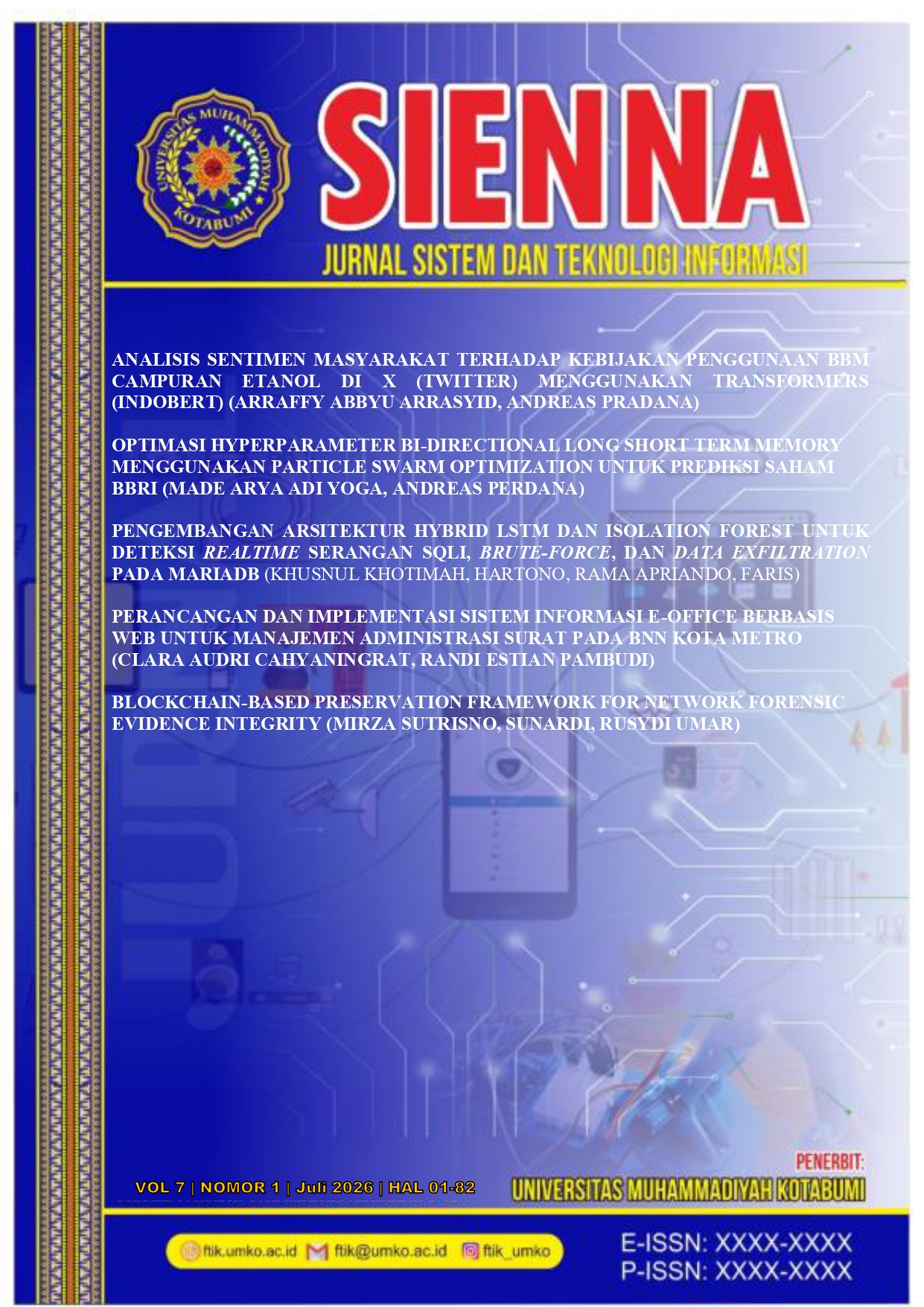
The Journal of Information Systems and Technology (SIENNA) has been published by the Faculty of Engineering and Computer Science (FTIK), University of Muhammadiyah Kotabumi (UMKO) since July 2020. SIENNA contains manuscripts of research results in the fields of Information Systems, Information Technology, and Computer Science. SIENNA (P-ISSN: 2745-987X and E-ISSN: 2745-9861) is committed to publishing quality articles in Indonesian so that they can become the main reference for researchers in the fields of Information Systems, Information Technology and Computer Science.
ISSN
2745-987X (printed) |
2745-9861 (online)
Published
2026-06-13
Accreditation

Articles
Analisis Sentimen Masyarakat terhadap Kebijakan Penggunaan BBM Campuran Etanol di X (Twitter) Menggunakan Transformers (IndoBERT)
Abstrak
The transition toward sustainable energy has become a strategic priority for Indonesia, particularly through the implementation of bioethanol-blended fuel policies. However, public perception toward this policy remains diverse and dynamic, especially as expressed on social media platforms. This study aims to analyze public sentiment regarding the implementation of bioethanol-blended fuel (E10) policies on X (Twitter) and to compare the performance of traditional machine learning and Transformer-based models in sentiment classification.
This research adopts a quantitative experimental approach using Natural Language Processing (NLP) techniques. A total of 2,501 tweets were collected through web crawling and processed using a Dual Pipeline Preprocessing approach. Sentiment labeling was conducted using the VADER method with manual validation. Two classification models were implemented, namely Support Vector Machine (SVM) as the baseline model and IndoBERT as the Transformer-based model. Model performance was evaluated using accuracy, precision, recall, and F1-score metrics.
The results indicate that the IndoBERT model outperforms SVM, achieving an accuracy of 81.64% and an F1-score of 81.39%, compared to SVM with an accuracy of 72.46% and an F1-score of 72.02%. The performance improvement of 9.18% demonstrates the superiority of Transformer-based models in capturing contextual semantics in unstructured social media text. In addition, sentiment analysis results reveal that public opinion is predominantly positive toward the policy, although concerns regarding technical and economic aspects remain.
This study contributes by providing empirical insights into public perception of energy policy and demonstrating the effectiveness of Transformer-based models for sentiment analysis in the Indonesian language context
 Google Scholar
 Garuda
 Sinta
Sinta
Pages: 1-20
62 views | 64 downloads
Statistics and Citations
Optimasi Hyperparameter Bi-Directional Long Short Term Memory Menggunakan Particle Swarm Optimization Untuk Prediksi Saham BBRI
Pasar modal, khususnya saham sektor perbankan seperti PT Bank Rakyat Indonesia (Persero) Tbk. (BBRI), sering kali menunjukkan volatilitas tinggi, sehingga membuat prediksi harga saham menggunakan metode konvensional menjadi sangat menantang. Tujuan penelitian ini adalah untuk meningkatkan keakuratan prediksi harga saham BBRI dengan mengintegrasikan arsitektur BiDirectional Long Short-Term Memory (Bi-LSTM) dan algoritma Particle Swarm Optimization (PSO). Salah satu tantangan utama dalam penerapan deep learning adalah penentuan kombinasi hyperparameter yang tepat. Oleh karena itu, PSO digunakan untuk mencari nilai optimal bagi parameter seperti ukuran tersembunyi, kecepatan pembelajaran, dan tingkat putus sekolah. Hasil penelitian menunjukkan bahwa PSO berhasil mengidentifikasi parameter optimal dengan learning rate sebesar 0.01000 danhidden size 96, yang memungkinkan model mencapai konvergensi pada epoch ke-29. Performa model yang dihasilkan menunjukkan akurasi yang baik dengan nilai Mean Absolute Percentage Error (MAPE) sebesar 1,32% dan Root Mean Squared Error (RMSE) sebesar 68,44. Kesimpulan dari penelitian ini menunjukkan bahwa penggunaan PSO dalam optimasi memberikan hasil yang cukup signifikan meningkatkan kemampuan Bi-LSTM dalam memodelkan Menggambarkan pola data waktu yang rumit, model ini bisa menjadi bantuan yang baik bagi investor dalam membuat keputusan investasi di pasar modal.
Development of a Hybrid LSTM and Isolation Forest Architecture for Realtime SQLi, Brute-Force, and Data Exfiltration Attack Detection on MariaDB
This research is in the field of cybersecurity and artificial intelligence, focusing on developing a real-time attack detection system for MariaDB databases. The research was motivated by the increasing threats of SQL injection (SQLi), brute-force attacks, and data exfiltration, which are increasingly difficult to detect using conventional rule-based methods. The objective of the research was to develop a hybrid architecture based on Long Short-Term Memory (LSTM) and Isolation Forest to improve detection accuracy while reducing false positives in modern database environments. The research method employed a Research and Development (R&D) approach through three main modules. The first module applies a bidirectional LSTM to detect SQLi based on query sequence analysis. The second module uses Isolation Forest and Rotated Isolation Forest to detect brute-force attacks through access behavior analysis. The third module applies Isolation Forest to detect data exfiltration based on traffic patterns and data transfer behavior. The entire dataset underwent preprocessing, feature engineering, tokenization, normalization, and performance evaluation using confusion matrices, precision, recall, F1-score, and AUC. The results show that the Bi-LSTM model achieved 99.99% accuracy in detecting SQLi. In brute-force detection, the standard Isolation Forest provided the best performance with a recall of 99.94% and an F1-score of 99.61%. Meanwhile, the data exfiltration module achieved a 100% detection rate on simulated exfiltration traffic with a combined accuracy of 94.92%. This study proves that the hybrid LSTM–Isolation Forest architecture is capable of providing accurate, adaptive detection and is feasible to be implemented as a next-generation MariaDB database security system.
Pages: 37-52
44 views | 40 downloads
Statistics and Citations
Perancangan dan Implementasi Sistem Informasi E-Office Berbasis Web untuk Manajemen Administrasi Surat pada BNN Kota Metro
Kemajuan teknologi informasi mendorong lembaga pemerintahan untuk meningkatkan efisiensi dalam pengelolaan administrasi, terutama dalam pengolahan surat yang masuk dan surat yang keluar. Di Badan Narkotika Nasional (BNN) Kota Metro, proses administrasi surat masih berjalan secara semi-manual yang dapat menimbulkan masalah seperti keterlambatan dalam pencarian arsip, duplikasi data, dan rendahnya efektivitas dalam pengelolaan dokumen. Penelitian ini bertujuan untuk merancang dan mengimplementasikan sistem informasi E-Office berbasis web yang dapat mendukung pengelolaan administrasi surat secara terintegrasi. Metode pengembangan sistem yang diterapkan adalah Agile, yang memungkinkan proses pengembangan berlangsung secara iteratif dan responsif terhadap kebutuhan pengguna. Sistem ini dibuat dengan bahasa pemrograman PHP yang dipadukan dengan framework CodeIgniter serta memanfaatkan database MySQL. Fitur utama yang dikembangkan mencakup pengelolaan surat masuk, surat keluar, disposisi surat, dan pencarian arsip dengan cepat dan tepat. Pengujian sistem dilaksanakan dengan metode Black Box Testing guna memastikan setiap fungsi beroperasi sesuai dengan kebutuhan pengguna. Temuan penelitian menunjukkan bahwa sistem yang dikembangkan dapat meningkatkan efisiensi dalam pengelolaan administrasi surat, memudahkan proses pengarsipan, dan mempercepat pencarian dokumen secara elektronik. Dengan demikian, penerapan sistem E-Office ini diharapkan mampu mendukung kinerja administrasi yang lebih efisien dan efektif di lingkungan BNN Kota Metro
Pages: 53-67
55 views | 48 downloads
Statistics and Citations
Blockchain-Based Preservation Framework for Network Forensic Evidence Integrity
Network forensic investigations rely heavily on the integrity and traceability of Packet Capture (PCAP) files as primary digital evidence. Digital Forensic Research Workshop (DFRWS) implementations commonly employ centralized preservation mechanisms that remain vulnerable to unauthorized modification and provide limited provenance transparency. To address these limitations, this study proposes a blockchain-based preservation framework integrated into the preservation phase of the DFRWS model. The framework combines SHA-256 cryptographic hashing for integrity verification, blockchain-based provenance logging, and distributed ledger validation while maintaining off-chain evidence storage. Unlike many existing blockchain-based forensic frameworks that primarily emphasize provenance recording and chain-of-custody management, this study evaluates evidence preservation through an integrated validation approach consisting of controlled tampering simulation, cryptographic sensitivity analysis, and preservation latency measurement. Experimental evaluation using PCAP datasets representing attack and baseline traffic conditions demonstrated that unauthorized evidence modification was successfully detected through hash inconsistencies. Avalanche Effect analysis produced a value of 50.39%, confirming the strong cryptographic sensitivity of the SHA-256 mechanism to minimal data alteration. While SHA-256 enables reliable tampering detection, the integrated blockchain architecture provides tamper-resistant provenance recording, chain-of-custody traceability, and distributed verification of evidence integrity. The framework achieved an average preservation latency of 2.057 seconds within the experimental environment, providing preliminary evidence of feasibility for blockchain-assisted forensic logging under controlled conditions. Although no direct comparison with alternative preservation approaches was conducted, the findings provide a proof-of-concept validation and contribute empirical evidence regarding the potential of blockchain-supported provenance management to enhance trustworthiness and integrity assurance in network forensic workflows.
Rancang Bangun Sistem Informasi Pengelolaan Administrasi Berbasis Web Pada MTS Darussholihin Hujung Untuk Peningkatan Efisiensi Tata Usaha
Perkembangan teknologi informasi mendorong lembaga pendidikan untuk meningkatkan kualitas pengelolaan administrasi secara efektif, efisien, dan terintegrasi. Salah satu aspek penting dalam administrasi sekolah adalah pengelolaan surat masuk, surat keluar, serta pengarsipan dokumen yang meliputi arsip aktif, arsip retensi, dan arsip inaktif. Pada MTs Darussholihin Hujung, proses pengelolaan administrasi masih dilakukan secara manual menggunakan pencatatan buku agenda dan penyimpanan dokumen fisik, sehingga berpotensi menimbulkan berbagai permasalahan seperti keterlambatan pencarian dokumen, risiko kehilangan arsip, duplikasi data, serta rendahnya efisiensi kerja tata usaha. Oleh karena itu, diperlukan suatu sistem informasi berbasis web yang mampu mendukung pengelolaan administrasi secara terkomputerisasi dan terstruktur.
Penelitian ini bertujuan untuk merancang dan membangun Sistem Informasi Pengelolaan Administrasi Berbasis Web pada MTs Darussholihin Hujung guna meningkatkan efisiensi tata usaha dalam pengelolaan surat dan arsip. Metode pengembangan sistem yang digunakan adalah metode Waterfall yang terdiri dari tahapan analisis kebutuhan, perancangan sistem, implementasi, pengujian, dan pemeliharaan. Sistem ini dikembangkan menggunakan framework CodeIgniter dengan bahasa pemrograman PHP dan basis data MySQL. Fitur utama sistem meliputi pengelolaan data surat masuk, surat keluar, arsip retensi, dan arsip inaktif yang terintegrasi dalam satu sistem informasi berbasis web. Pengujian sistem dilakukan menggunakan metode Blackbox Testing untuk memastikan bahwa seluruh fungsi sistem berjalan sesuai dengan kebutuhan pengguna.
Hasil penelitian ini berupa sistem informasi administrasi berbasis web yang menyediakan menu dashboard, surat masuk, surat keluar, arsip retensi, dan arsip inaktif. Sistem ini mempermudah pencatatan, pencarian, dan pengelolaan dokumen, mengurangi kesalahan serta risiko kehilangan arsip, sehingga meningkatkan efisiensi, keamanan, dan kerapihan administrasi tata usaha.
Indexer Sites