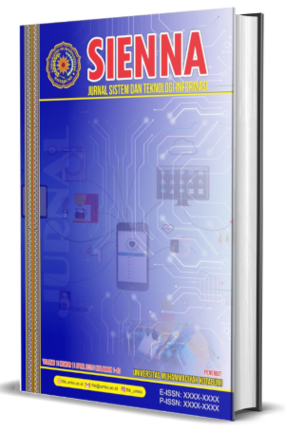
Author Guidelines
The Journal of Information Systems and Technology (SIENNA) (P-ISSN: 2745-987X | E-ISSN: 2745-9861) is a peer-reviewed academic journal published since 2020 by the Faculty of Engineering and Computer Science, in collaboration with the Institute for Research and Community Service (LPPM), Universitas Muhammadiyah Kotabumi (UMKO), Indonesia. SIENNA provides a scholarly platform for the publication and dissemination of high-quality original research, critical theoretical studies, and advanced academic discourse in the fields of Information Systems, Information Technology, and Computer Science.
The journal is committed to publishing innovative, rigorous, and relevant contributions that enhance understanding and practical application within its thematic scope.
Manuscript Submission Guidelines
1. General Requirements
- Manuscripts must be original and unpublished, and must not be under consideration by other journals or publishers.
- Submissions must relate to theoretical discourse or, preferably, empirical research within the journal’s fields of interest.
- Manuscripts should be written in clear and academic English or Bahasa Indonesia.
- The length of the manuscript should be between 8 and 15 pages, including references.
- The manuscript must be typed in MS Word, using Times New Roman, font size 12, 1.5 line spacing, on A4 paper with 3 cm left margin and 2.5 cm for top, bottom, and right margins.
2. Manuscript Structure
A. Empirical Research Articles
Each manuscript should include the following elements, with approximate percentage of total content:
- Title, Author Name(s), and Affiliation(s)
- Abstract in English and Bahasa Indonesia (150–200 words each)
- Keywords (3–6 words or phrases)
- Introduction (25%)
Includes background, literature review, research problem, objectives, theoretical framework, and hypotheses (if applicable) - Research Methodology (15%)
Describes the research design, population/sample or data sources, instruments, data collection techniques, and data analysis methods - Results (25%)
- Discussion (30%)
- Conclusion and Recommendations (5%)
- References
B. Theoretical or Critical Review Articles
The structure should follow this format:
- Title, Author Name(s), and Affiliation(s)
- Abstract in English and Bahasa Indonesia (150–200 words each)
- Keywords (3–6)
- Introduction (15%)
States the background, problem, purpose, and scope - Main Discussion (75%)
Organized into sub-sections with literature analysis and critical discussion - Conclusion and Recommendations (10%)
- References
3. Additional Requirements
- Include the location and date of article completion and revision at the end of the manuscript.
- Provide a short author biography and research identity as a footnote on the first page of the article.
- Manuscripts must be submitted at least two months before the intended publication month through https://jurnal.umko.ac.id
- Notification of acceptance or rejection will be communicated through the same portals.
4. Plagiarism Policy
- Manuscripts must be free from plagiarism.
- The journal allows a maximum similarity index of 25%, as checked by plagiarism detection software.
5. Reference and Citation Guidelines
- Manuscripts must consistently follow the APA (American Psychological Association) citation style, both in-text and in the reference list.
- References should predominantly consist of sources published within the last 10 years (minimum 85%).
- Authors are strongly encouraged to use reference management tools such as Mendeley, Zotero, or EndNote.
Reference Formatting:
- Books:
Surname, First Name. (Year). Title: Subtitle. City: Publisher. - Journal Articles:
Surname, First Name. (Year). “Article Title.” Journal Name, Volume(Issue), pages. - Online Journal Articles:
Surname, First Name. (Year). “Article Title.” Journal Name, Volume(Issue), pages. Retrieved from URL - For works with more than three authors, list the first author followed by “et al.” in the in-text citation.
Template and Consistency
- All manuscripts must conform to the official journal template.
- Inconsistent formatting or deviation from guidelines may result in delays or rejection.