Focus and Scopes
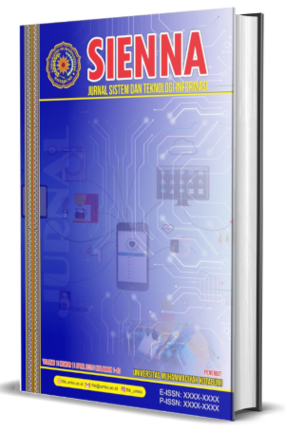
The Journal of Information Systems and Technology (SIENNA) is a peer-reviewed scientific journal published by the Faculty of Engineering and Computer Science (FTIK), Universitas Muhammadiyah Kotabumi (UMKO), since July 2020. SIENNA consistently publishes high-quality research manuscripts in the fields of Information Systems, Information Technology, and Computer Science. With a primary focus on publishing in the Indonesian language, SIENNA is committed to serving as a leading reference for researchers, academics, and professionals working in these areas.
The journal welcomes original research articles, conceptual studies, and case analyses that fall within the following broad scopes:
1. Domain-Specific Frameworks and Applications
- IT Management and IT Governance: Covers research on the management of information systems, IT strategies, IT service management, cybersecurity policies, digital transformation, and overall governance of technological infrastructure within organizations.
- e-Government: Focuses on the application of information technology in government operations, including digital public services, smart governance, citizen participation, and the implementation of open data systems.
- e-Learning, e-Manufacturing, and e-Commerce: Explores the implementation and impact of information technology in distance learning, electronic manufacturing systems, online marketplaces, and digital transaction ecosystems.
2. Smart Systems
- Smart Cloud Technology: Investigates the integration of artificial intelligence with cloud computing to enable scalable, efficient, and adaptive IT resource management and service delivery.
- Robotic Systems: Studies the design, development, and deployment of robotic technologies in industrial automation, healthcare, agriculture, and public services.
- Smart Sensor Networks: Analyzes intelligent sensor networks for monitoring, data acquisition, and real-time response in domains such as environmental monitoring, agriculture, and smart cities.
- Information Infrastructure for Smart Living Spaces: Examines smart infrastructure solutions for urban environments, including IoT integration, ambient intelligence, and data-driven management of residential and urban systems.
3. Models, Methods, and Techniques
- Conceptual Modeling, Languages, and System Design: Discusses theories and techniques in developing conceptual models, domain-specific modeling languages, and the design of information systems.
- Software Engineering: Covers software development methodologies, agile and DevOps practices, project management, testing, and quality assurance in software projects.
- Information-centric Networking: Explores networking paradigms centered around content distribution and efficient data retrieval rather than traditional host-based communication.
- Media, Game, and Mobile Technologies: Highlights innovations in digital media, interactive entertainment (games), and mobile platforms, including their development and application in various sectors.
- Data Mining: Investigates techniques for discovering patterns, knowledge, and actionable insights from large-scale structured and unstructured datasets.
- Information Retrieval: Focuses on algorithms and systems for effective information search, indexing, and knowledge discovery in digital repositories.
- Information Security: Studies data protection techniques, cryptographic systems, threat modeling, cybersecurity frameworks, and secure system design.
- Image Processing and Pattern Recognition: Explores methods for digital image enhancement, feature extraction, object detection, and visual pattern classification in computer vision applications.
- Natural Language Processing (NLP): Examines the computational processing of human language, including syntactic and semantic analysis, machine translation, sentiment analysis, and intelligent text generation.
Through this comprehensive scope, SIENNA seeks to become a significant platform for the exchange of knowledge and the advancement of scientific and practical innovations in Information Systems, Information Technology, and Computer Science. The journal fosters interdisciplinary collaboration and encourages submissions that provide theoretical advancements, practical implementations, and empirical findings that contribute to the ongoing development of digital technologies and their applications.