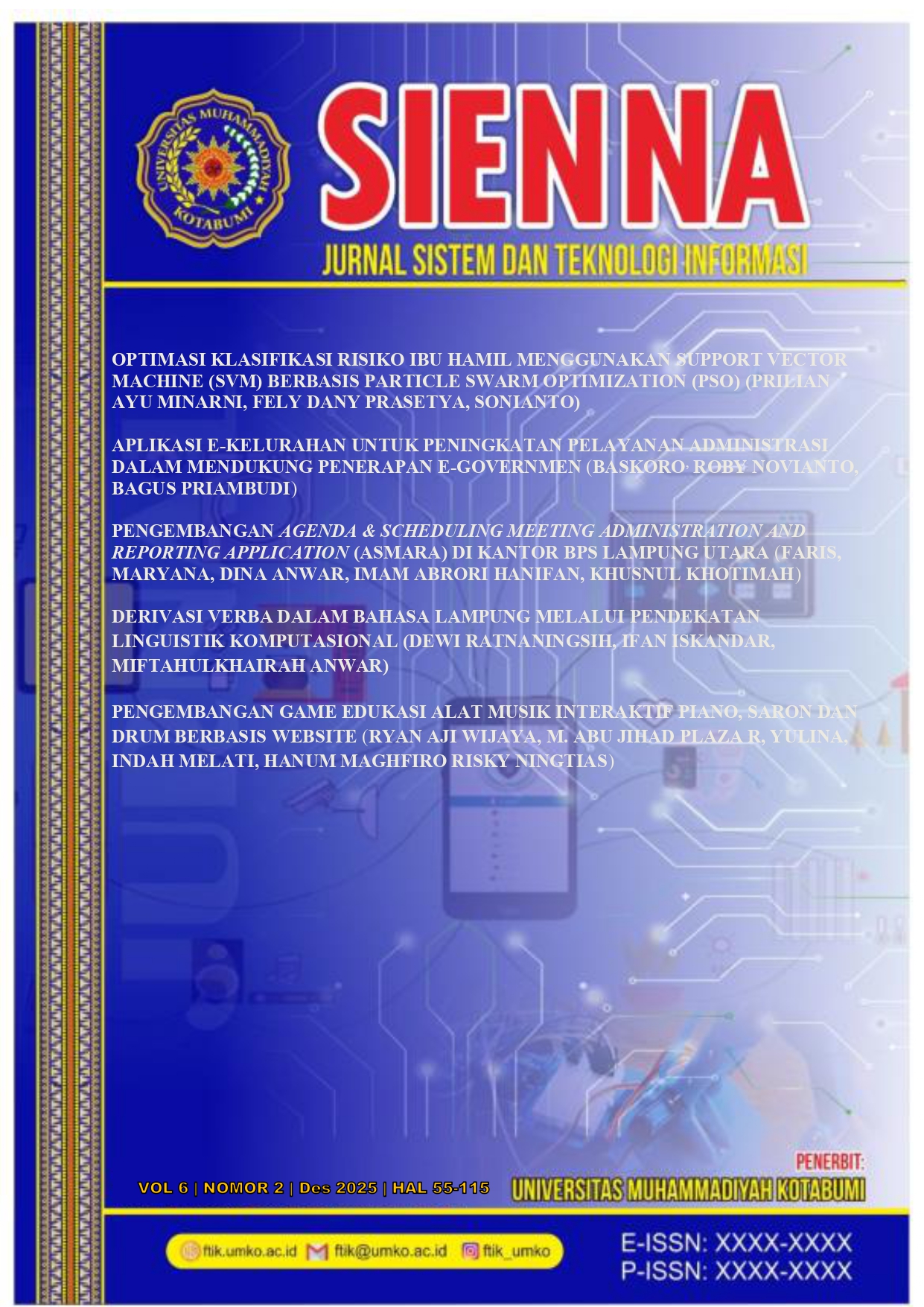
The Journal of Information Systems and Technology (SIENNA) has been published by the Faculty of Engineering and Computer Science (FTIK), University of Muhammadiyah Kotabumi (UMKO) since July 2020. SIENNA contains manuscripts of research results in the fields of Information Systems, Information Technology, and Computer Science. SIENNA (P-ISSN: 2745-987X and E-ISSN: 2745-9861) is committed to publishing quality articles in Indonesian so that they can become the main reference for researchers in the fields of Information Systems, Information Technology and Computer Science.
ISSN
2745-987X (printed) |
2745-9861 (online)
Published
2025-12-30
Accreditation

Articles
Optimasi Klasifikasi Risiko Ibu Hamil Menggunakan Support Vector Machine (SVM) Berbasis Particle Swarm Optimization (PSO)
Accurate classification of pregnancy risk is crucial for early detection of complications and reducing maternal and infant mortality rates. However, existing classification models still face challenges in terms of accuracy, particularly in distinguishing between high and very high-risk classes. This study aims to improve the accuracy of pregnancy risk classification models by optimizing Support Vector Machine (SVM) using Particle Swarm Optimization (PSO) algorithm. The study utilizes the "Maternal Health Risk Data" dataset available on Kaggle, which contains information on maternal health. The data is analyzed using two models: standard SVM and SVM optimized with PSO. Evaluation is conducted by comparing the accuracy, precision, recall, and F1-score of both models. The application of SVM without PSO resulted in an accuracy of 77.72%, whereas after optimization with PSO, the accuracy increased to 89.92%. Significant improvements were also observed in precision (from 79.37% to 89.49%) and recall (from 78.81% to 89.55%). The F1-score of the PSO-based SVM model reached 89.52%, demonstrating a good balance between precision and recall.
 Google Scholar
 Garuda
 Sinta
Sinta
Pages: 55-62
85 views | 93 downloads
Statistics and Citations
Rancang Bangun Sistem Penjualan Bunga Di Lembur Kuring Mini Garden
This study aims to develop a desktop-based sales information system to address the limitations of manual data recording at Lembur Kuring Mini Garden, a small business specializing in flower seedlings. Rapid advancements in information technology and the need for accurate, structured, and efficient data processing highlight the importance of computerized systems in supporting business operations. Manual processes such as recording customer data, stock inventory, and sales transactions often lead to errors, data duplication, and delays in decision-making. To overcome these issues, the system was developed using the Software Development Life Cycle (SDLC), which includes planning, analysis, design, implementation, and testing. The application was built using Visual Studio 2012 with C# and SQL Server as the database management system, while Crystal Reports was utilized for generating sales and inventory reports. Data collection was conducted through interviews to obtain system requirements directly from the business owner. The implemented system consists of modules for managing customer data, flower stock, and sales transactions, each equipped with essential functions including add, edit, delete, search, and report generation. Black Box Testing was employed to evaluate system functionality, focusing on input validation, process accuracy, interface responsiveness, and output correctness, all of which showed successful results. The findings indicate that the developed system effectively replaces the previous manual process, improves operational efficiency, reduces recording errors, and provides more organized and reliable information to support decision-making. Overall, the system demonstrates its feasibility and relevance for small businesses that require structured and efficient sales and inventory management.
Pengembangan Agenda & Scheduling Meeting Administration and Reporting Application (ASMARA) Di Kantor BPS Lampung Utara
The inefficiency of manual meeting scheduling at the North Lampung Regency Central Statistics Agency (BPS) has led to frequent data conflicts and communication delays. Conventional calendar applications often fail to accommodate the specific bureaucratic requirement for hierarchical approval before an agenda is publicized. This study aims to develop the Agenda & Scheduling Meeting Administration and Reporting Application (ASMARA) to streamline the scheduling process. The research employs a qualitative applied approach using the Waterfall development method, encompassing requirements analysis, system design, implementation, and testing. The system is built using the Laravel framework and Vue.js, integrated with a Node.js-based WhatsApp Gateway service. The result is a web-based application featuring a role-based approval workflow, where meeting agendas created by staff must be validated by the Head of Office or Sub-division Head. Once approved, the system automatically triggers real-time WhatsApp notifications to all participants. Testing results indicate that ASMARA effectively eliminates scheduling conflicts, ensures administrative accountability through digital approval tracking, and significantly improves information dissemination speed among BPS employees
Pages: 73-82
32 views | 47 downloads
Statistics and Citations
Derivasi Verba dalam Bahasa Lampung melalui Pendekatan Linguistik Komputasional
This study presents a comprehensive analysis of verbal derivation in Lampung Language Dialects A and O, employing a computational linguistic approach to identify affixation patterns, morphophonemic processes, and the semantic and syntactic contributions of affixes. Verbal data were categorized according to prefixes, infixes, suffixes, and circumfixes. The findings show that both dialects exhibit highly consistent verbal derivation systems. The nasal prefix (N-) is the most productive, marking active transitivity and causativity, with identical nasal assimilation processes in both dialects (b/p → m-, d/t → n-, k/g → ng-, s/c/j → ny-, vowels → nge-/ng-). Other prefixes, such as di-, consistently indicate passivization, while be-/ber- and te-/ti- signal reciprocal/stative verbs and unintentional passives. Major suffixes (-ken, -ko, -an, -kon) function as causative, applicative, or result markers, whereas infixes (-el-, -em-, -en-, -er-) primarily modify phonology or add semantic nuance. Dialect comparison confirms strong structural similarity, with minor phonetic variations, such as object suffixes (-ni/-na in Dialect A vs. -no in Dialect O) and less productive affixes (bu- in Dialect A, per- in Dialect O). Formalization of derivation rules in Python successfully predicted most derived forms, although further refinement is needed for nasal assimilation on vowel-initial stems and vowel deletion in suffixation. This study underscores the fundamental similarity in Lampung verbal morphology and opens opportunities for computational linguistic applications, including morphological analyzers, translation tools, and language learning systems, which are vital for the preservation of regional languages. The results also contribute to a deeper understanding of Austronesian morphological typology.
Pages: 83-106
71 views | 87 downloads
Statistics and Citations
Perancangan Game Edukasi Alat Musik Interaktif Piano, Saron dan Drum Berbasis Web
In an era of rapidly evolving technology, the advancement of online applications has become a powerful method for enhancing children's imagination and abilities across various fields, including music. This research focuses on the design and implementation of an electronic smart music game for three instruments: piano, saron, and drums, based on a web platform. The primary objective of this application is to attract children's interest in learning instruments through engaging and easily accessible online media. The development technique employed is the Software Development Life Cycle (SDLC) using the Waterfall model, which integrates the phases of requirements analysis, planning, implementation, and testing. Use case diagrams, activity diagrams, and sequence diagrams were utilized during the planning stage to define the system framework using Unified Modeling Language (UML). The implementation was completed using Visual Studio Code and programming languages including HTML, CSS, and JavaScript. The results of this design indicate that this music game application can effectively and enjoyably assist children in learning musical instruments. Furthermore, the application fosters children's interest in music while supporting their cognitive and emotional development. With its simple and accessible features, this application is expected to become a significant asset for music and social education in Indonesia, while helping to build awareness and enthusiasm for both traditional and modern music.
Pages: 107-115
43 views | 72 downloads
Statistics and Citations
Model Implementasi Telemedicine Berbasis Teknologi Informasi di Puskesmas Kotabumi Ilir
The development of information technology is driving the transformation of health services through the use of telemedicine, particularly in community health centers (Puskesmas) as first-level health facilities that play a strategic role in improving access and quality of public health services. However, its implementation still faces technical, organizational, and environmental challenges, necessitating a study on the readiness and implementation model of telemedicine at the Sindang Sari Community Health Center in Kotabumi. The urgency of this research lies in the need to map the actual readiness of community health centers in adopting telemedicine sustainably and formulate a contextual implementation model according to the characteristics of primary health care. The novelty of this research is demonstrated through the use of the Technology–Organization–Environment (TOE) Framework to analyze the implementation of telemedicine in an integrated manner using a case study approach. The problem formulation focuses on the level of readiness for telemedicine implementation, the technological, organizational, and environmental factors that influence it, and an effective implementation model. This study aims to analyze community health center readiness, identify determinants of implementation, and develop an applicable implementation model. The research method employed a qualitative approach through in-depth interviews, observation, and documentation, with thematic data analysis based on the TOE Framework. The results indicated that readiness was in the moderately prepared category, with the technology dimension dominating, while the organizational and environmental dimensions still needed strengthening. The conclusion confirms that successful telemedicine implementation requires the ongoing integration of technological readiness, organizational capacity, and environmental support.
Pages: 116-130
30 views | 33 downloads
Statistics and Citations
Perancangan dan Pengembangan Prototype Aplikasi Pencatatan dan Pemantauan Perkembangan Mahasiswa Berkebutuhan Khusus Berbasis Web Mobile
Pendidikan inklusif di lingkungan pendidikan tinggi menuntut sistem pemantauan intensif untuk kemajuan mahasiswa berkebutuhan khusus (MBK). Namun, fakta di lapangan menunjukkan bahwa proses pencatatan perkembangan mahasiswa masih didominasi oleh metode manual, yang mengakibatkan risiko kehilangan data yang tinggi dan koordinasi yang lambat antara dosen pembimbing, asisten, dan institusi. Penelitian ini bertujuan untuk merancang dan mengembangkan prototipe aplikasi berbasis web-mobile untuk mencatat dan memantau kemajuan mahasiswa berkebutuhan khusus guna meningkatkan efisiensi administrasi dan akurasi data. Metode pengembangan sistem yang diterapkan adalah metode Prototyping, dipilih karena fleksibilitasnya dalam mengakomodasi kebutuhan pengguna yang sangat spesifik melalui proses iteratif evaluasi dan revisi. Tahapan penelitian meliputi identifikasi kebutuhan pengguna, pembuatan prototipe awal, evaluasi pemangku kepentingan, dan implementasi pengkodean sistem. Aplikasi ini dirancang menggunakan teknologi web responsif untuk memastikan aksesibilitas optimal melalui perangkat mobile bagi asisten di lapangan. Hasil penelitian menunjukkan bahwa pendekatan prototyping sangat efektif dalam memetakan fitur aksesibilitas dan fungsionalitas yang dibutuhkan untuk memantau mahasiswa berkebutuhan khusus. Keberadaan aplikasi ini memfasilitasi pelaporan kemajuan secara real-time, meminimalkan kesalahan manusia dalam pengelolaan informasi, dan mendukung pengambilan keputusan intervensi pendidikan yang lebih cepat dan akurat. Dengan sistem terintegrasi, lembaga pendidikan tinggi dapat memberikan layanan bantuan yang lebih profesional, transparan, dan berkelanjutan bagi mahasiswa berkebutuhan khusus.
Pages: 131-142
43 views | 44 downloads
Statistics and Citations
Indexer Sites