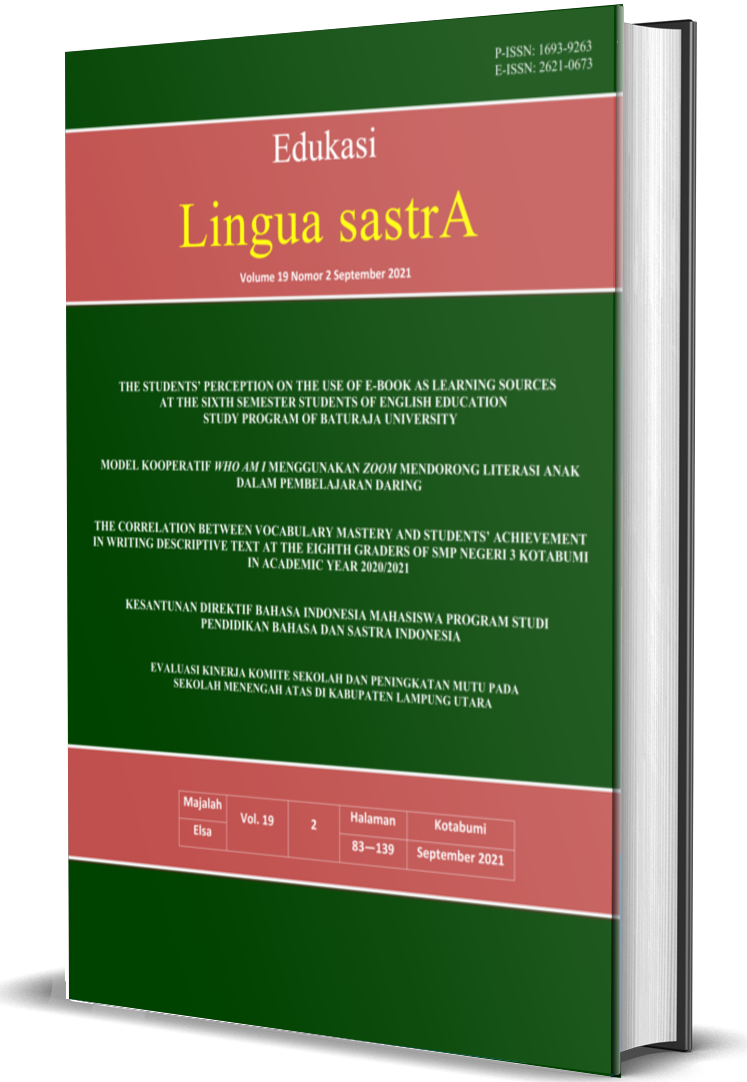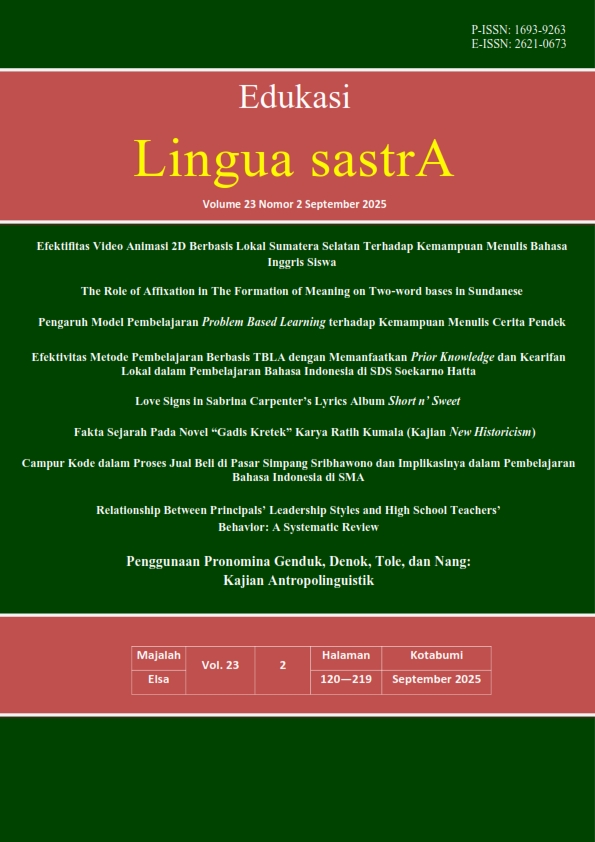
Edukasi Lingua Sastra (e-ISSN: 2621-0673 and p-ISSN: 1693-9263) is journal that published since 2002 (printed version) by University of Muhammadiyah Kotabumi. This journal publishes original papers researching such as; results of critical studies, research results in education, literary language and literature and language education. Edukasi Lingua Sastra has regularly published two times a year in April and September. The procedure starts with the submission process, plagiarism check, review, revision, plagiarism check, and finally publish.
Readmore
ISSN
1693-9263 (printed) |
2621-0673 (online)
Published
2025-07-28
Accreditation

Articles
Efektifitas Video Animasi 2D Berbasis Lokal Sumatera Selatan Terhadap Kemampuan Menulis Bahasa Inggris Siswa
The objectives of the study are 1) To find out the significant differences between the students who are taught by using 2D animation videos based on local South Sumatra culture and those who are taught by using conventional models on students' writing skills, 2) To improve the understanding of South Sumatra's local culture such as traditions, customs, art or cultural values, and 3) To integrate the multimedia technology in learning by using 2D animation videos, and preserving the manuscripts of the South Sumatra archipelago. The method used is experimental with a writing ability test and a learning motivation questionnaire as an instrument for collecting the data. Based on the results of data analysis, it can be seen that there is any significances among two classes, and feasible to be used to build the students' characters by moral values.
 Google Scholar
 Garuda
 Sinta
Sinta
Pages: 120-129
261 views | 285 downloads
Statistics and Citations
The Role of Affixation in the Formation of Meaning on Two-word bases in Sundanese
Indonesia is an archipelagic country rich in languages. This study discusses one of the regional languages in Indonesia, which is Sundanese. This research investigates the role of affixation in the formation of meaning on the base word two in Sundanese, contributing to the field of morphology within linguistics. The study is motivated by the limited exploration of affixation involving numerical bases in Sundanese, particularly among younger speakers who often exhibit inconsistent usage due to lack of systematic understanding. Using a qualitative content analysis method, data were collected from three Sundanese novels: Baruang Kanu Ngarora by D.K. Ardiwinata, Si Bedog Panjang by Ki Umbara, and Kabungbulengan by Hanna Djumhana Bastaman. The research identifies various forms of affixation such as prefixes (e.g., ka-, mi-, nga-), suffixes (e.g., -an, -na), and confixes (e.g., pa-…-an, mang-…-keun) that attached to the base word two. These affixes generate diverse semantic and pragmatic meanings, ranging from sequence and togetherness to actions involving two parties, as well as culturally spesific connotations like polygamy or disloyalty. The findings demonstrate that affixation in Sundanese does not merely serve morphological functions but also enriches the language’s capacity to express nuanced social and cultural interactions. This study contributes new insights to the understanding of Sundanese morphology and supports the preservation of regional languages amid rapid digital and intercultural development.
Pages: 130-138
148 views | 181 downloads
Statistics and Citations
Pengaruh Model Pembelajaran Problem Based Learning terhadap Kemampuan Menulis Cerita Pendek
This study aims to determine the effect of the application of the Problem Based Learning learning model on the ability to write short stories for grade XI MAS Darul Mutaallimien students for the 2024/2025 school year. The type of research used is quantitative research with an experimental method, in the form of One-Group Pretest-Posttest Design. The research subjects consisted of 26 students of class XI B MAS Darul Mutaallimien for the 2024/2025 school year. The data collection techniques used include tests, observations and documentation. Based on the results of initial observations through the pretest, it was shown that the student's score of writing short stories was 59.69. This shows that students' ability to write short stories is relatively low. However, after students were given treatment in the form of applying the Problem Based Learning learning model and conducting a posttest, there was a significant increase in the average score of students to 79.81. Therefore, a t-test was carried out with a significance value of 0.000<0.05, in addition to a hypothesis test was carried out that showed that the tcount (9,720) was greater than the ttable (1,704). This shows that H0 is rejected and H1 is accepted. Thus, it can be stated that the Problem Based Learning learning model has an effect on the ability to write short stories for grade XI MAS Darul Mutaallimien students for the 2024/2025 school year.
Pages: 139-147
227 views | 254 downloads
Statistics and Citations
Efektivitas Metode Pembelajaran Berbasis TBLA dengan Memanfaatkan Prior Knowledge dan Kearifan Lokal dalam Pembelajaran Bahasa Indonesia di SDS Soekarno Hatta
This study examines the effectiveness of a Task-Based Language Assessment (TBLA) method integrated with students' prior knowledge and the local wisdom of Piil Pesenggiri in Indonesian language learning. The research employed the ADDIE model combined with lesson study, involving fifth-grade elementary students as subjects. Results demonstrated significant improvements in: (1) average learning outcomes (77.25, categorized as "good"), (2) critical thinking skills (25% increase), and (3) discussion participation (30% increase). TBLA transcript analysis revealed that incorporating nemui nyimah (hospitality) and sakai sambayan (mutual cooperation) values created contextual and inclusive learning. The STAD model effectively enhanced student collaboration, with 85% of groups showing productive interactions. These findings confirm that culturally-grounded TBLA approaches not only improve language competence but also strengthen cultural identity. The study recommends using authentic tasks based on local wisdom, transcript analysis for teacher reflection, and adaptive performance-based assessment. Practical implications include designing Indonesian language instruction that aligns with students' socio-cultural contexts.
Pages: 148-160
190 views | 181 downloads
Statistics and Citations
Love Signs in Sabrina Carpenter's Lyrics Album Short n' Sweet
This study aims to describe the representamen, object, and interpretant found in Sabrina Carpenter’s lyrics and how those elements reflect the types of love. This research is classified as descriptive qualitative research. The researcher uses content analysis with an interpretive framework based on Charles Sander Peirce’s semiotics theory. The data for this research consist of the lyrics of three songs from Sabrina Carpenter’s Short n’ Sweet album entitled “Please Please Please”, “Juno”, and “Sharpest tool”. The research result show that there are three types of love in the lyrics of these songs: self love, intimate love, and obsessive love. The love signs in the songs are conveyed through peirce’s triadic theory, which includes representamen,object, and interpretant. The songs in this album are narrated from a first-person point of view, and the narrator also exhibits characteristics of woman’s language, including lexical hedges, intensifiers, emphatic stress, super polite forms, tag questions, empty adjectives, and precise color terms.
Pages: 161-170
268 views | 499 downloads
Statistics and Citations
Fakta Sejarah Pada Novel “Gadis Kretek” Karya Ratih Kumala (Kajian New Historicism)
This research aims to analyze the novel Gadis Kretek by Ratih Kumala using the New Historicism approach. This approach examines how literary works not only reflect but also participate in the construction of social, cultural, and political realities within specific historical context. The novel was selected due to its rich historical, social, and cultural narrative, particularly related to Indonesia’s clove cigarette (kretek) industry from the colonial period to the New Order era. The research uses a qualitative descriptive mthod with reading-note techniques and interpretive analysis of excerpts that depict representation of history, society, economy, education, and culture. The findings reveal that Gadis Kretek represents Javanese society in various dimensions, including social inequality, patriarchal systems, colonial repression, and the role of local culture in shaping national identity. The novel illustrates how power operates through historical and economic discourse. Therefore, Gadis Kretek stands as a culturally rich text that is highly relevant for analysis through the lens of New Historicism.
Pages: 171-181
464 views | 503 downloads
Statistics and Citations
Campur Kode dalam Proses Jual Beli di Pasar Simpang Sribhawono dan Implikasinya terhadap Pembelajaran Bahasa Indonesia di SMA
Linguistic diversity in heterogeneous communities, such as in markets, can trigger code-mixing events that are important to study. The purpose of this research is to describe the forms and factors contributing to code-mixing in buying and selling activities in the market and to apply the findings to the teaching of the Indonesian language in high school. The research approach used is qualitative with a descriptive method. The data in this study consists of utterances containing code-mixing. The data sources were interactions between sellers and buyers at Simpang Sribhawono Market. Data collection techniques included observation, documentation, recording, and transcription. The data obtained were analyzed using an interactive data analysis model. The results of the study indicate the occurrence of code-mixing in buying and selling transactions at Pasar Simpang Sribhawono. The most commonly found type of code-mixing is in the form of words, followed by phrases and clauses. This code-mixing primarily occurs due to situational factors. In addition, a secondary factor contributing to code-mixing is the use of terms considered more appropriate and commonly used. The findings of this study are implicated in the teaching of Indonesian language in Phase E, as high school students generally have knowledge of the diversity of regional languages in Indonesia as well as foreign languages. This implication is applied in the teaching of negotiation texts, emphasizing linguistic aspects while also serving as a concrete example for students to practice writing negotiation texts.
Pages: 182-189
165 views | 126 downloads
Statistics and Citations
Relationship Between Principals’ Leadership Styles and High School Teachers’ Behavior: A Systematic Review
This systematic review explores the relationship between principals’ leadership styles and high school teachers’ behaviors, focusing on areas such as instructional practice, collaboration, job satisfaction, and organizational commitment. Drawing on empirical studies published between 2010 and 2024, the review synthesizes findings to understand how transformational, transactional, and instructional leadership styles influence teacher engagement and performance. The analysis reveals that transformational leadership consistently fosters positive outcomes by promoting motivation, emotional investment, and professional development. Instructional leadership emerges as a key driver of teaching effectiveness through curriculum support and collaborative planning. In contrast, transactional and laissez-faire approaches are associated with limited teacher autonomy and reduced morale. The study also highlights the mediating role of school culture in shaping teacher behavior and underscores the importance of contextual factors such as school size, socio-economic status, and teacher experience. Recommendations include enhancing principal training programs to develop transformational and participatory leadership skills, fostering inclusive decision-making, and cultivating supportive school environments. This review contributes to the ongoing discourse on educational leadership by identifying critical leadership practices that enhance teacher performance and student outcomes in secondary education settings.
Pages: 190-199
151 views | 134 downloads
Statistics and Citations
Penggunaan Pronomina Genduk, Denok, Tole, dan Nang: Kajian Antropolinguistik
The use of the pronouns genduk, denok, tole, and nang among the Javanese people represents a way of using language that reflects social and cultural values. This study aims to explain the use of these pronouns based on gender and social contexts, as well as to understand their meanings. The data were obtained from five informants of Javanese ethnicity, aged between 21 and 60 years, representing various generations. This research is of a qualitative descriptive type. The methods of observation and conversation were used during the data collection process. The observation techniques included note-taking, audio recording, and participatory observation (conversing while listening). The conversational techniques involved face-to-face and non-face-to-face interviews. A comparative technique (HBB) was employed to evaluate the data using an extralingual equivalence method. Based on the research findings, the pronouns genduk and denok are used for girls and signify intimacy, affection, and social norms influenced by social context and dialect. For boys, the pronouns tole and nang are used to indicate gender identification, emotional closeness, and age hierarchy. All of these pronouns serve as cultural markers that influence attitudes and social interactions within Javanese society, as well as function as useful communication tools. The Sapir–Whorf theory, which emphasizes the reciprocal relationship between language, culture, and thought, aligns with these observations. Therefore, through the use of the pronouns genduk, denok, tole, and nang, the sociocultural processes of Javanese culture and the preservation of traditional values within the community are reflected
Clue and Red Herrings in Enola Holmes (2020) and Enola Holmes 2 (2022)
This research explores the role of clues and red herrings in Enola Holmes (2020) and Enola Holmes 2 (2022), both directed by Harry Bradbeer and produced by Netflix. The detective genre has long relied on the interplay between genuine clues, which guide the detective toward resolution, and red herrings, which intentionally mislead to sustain suspense. While previous studies have examined the detective formula in classic novels or focused on thematic aspects such as gender and adaptation in the Enola Holmes films, few have analyzed how cinematic techniques highlight the presence of clues and red herrings in modern screen narratives. This study employs a descriptive qualitative method, with primary data drawn from selected scenes, dialogues, and cinematic elements in both films, analyzed through John G. Cawelti’s classical detective formula and supported by secondary references. The findings reveal that clues often appear through symbolic objects, coded texts, and visual motifs, while red herrings are created through misinterpretations or staged evidence. Cinematic techniques such as close-ups, lighting contrasts, and mise-en-scène are used to emphasize both genuine and misleading information, actively involving viewers in the interpretive process. The results show that while Enola Holmes (2020) focuses more on personal and familial dimensions, Enola Holmes 2 (2022) incorporates broader social issues, offering a denser layering of clues and red herrings. This study contributes to detective fiction scholarship by demonstrating how classical narrative structures are adapted in contemporary cinema to balance logic, suspense, and audience engagement.
Pages: 220-240
183 views | 139 downloads
Statistics and Citations
Pelestarian Tari Bedayo Tulang Bawang melalui Pembelajraan Tari Lampung Pepadun
This study aims to describe the preservation of the Bedayo Tulang Bawang Dance through the Lampung Pepadun Dance course at the University of Lampung. This study uses a qualitative method with descriptive data description. Data collection was carried out through interviews and documentation. Interviews were conducted with lecturers of the Lampung Pepadun Dance course and documentation was obtained from students of the Dance Education study program from the lecture process, practice, and exams of the Lampung Pepadun Dance. The results of the study show that there are five preservation processes carried out, namely; (1) first through integration into the curriculum. This was done by adding the Lampung Pepadun Dance course to the curriculum in the Dance Education study program and making the Bedayo Tulang Bawang Dance the main material; (2) second through training or direct practice of the Bedayo Tulang Bawang Dance movements in lecture classes; (3) third by holding performances and appreciation through the Bedayo Tulang Bawang Dance performance at Campus A, University of Lampung and at the Open Theater Building (GTT) of the Lampung Provincial Cultural Park as a lecture output; (4) fourth through documentation. Students are required to record the performance and upload the documentation to the Unila Dance Education YouTube channel and social media accounts. At the documentation stage, students also made a performance report in the form of a paper; (5) fifthly, collaboration with traditional communities or artists was carried out by interviewing the resource person and dance creator Ibu Linggar Nunik Kiswari.
Pages: 241-251
58 views | 67 downloads
Statistics and Citations
The Effectiveness of The “PRAAT” Application in Improving Students' Phonemes Pronunciation
This study aims to examine the effectiveness of the PRAAT application in improving students' pronunciation, focusing on close mid vowels, plosive consonants, and fricative consonants. Pre-test and post-test data were collected from 50 participants to evaluate changes in pronunciation after the intervention using PRAAT. The average spectrum deviation in the pre-test was 24.5%, which decreased to 14.3% in the post-test, with a total gain of 10.2%. This significant reduction indicates an improvement in pronunciation, approaching the standard of native speakers in the analyzed phoneme categories. Statistical analysis revealed a significant change with a p-value < 0.001, affirming that PRAAT plays a crucial role in enhancing students' pronunciation quality. These findings provide empirical evidence that PRAAT is effective as a tool for improving the pronunciation of specific phonemes in language learning and recommend its broader application in educational contexts.
Pages: 252-259
47 views | 57 downloads
Statistics and Citations
Indexer Sites