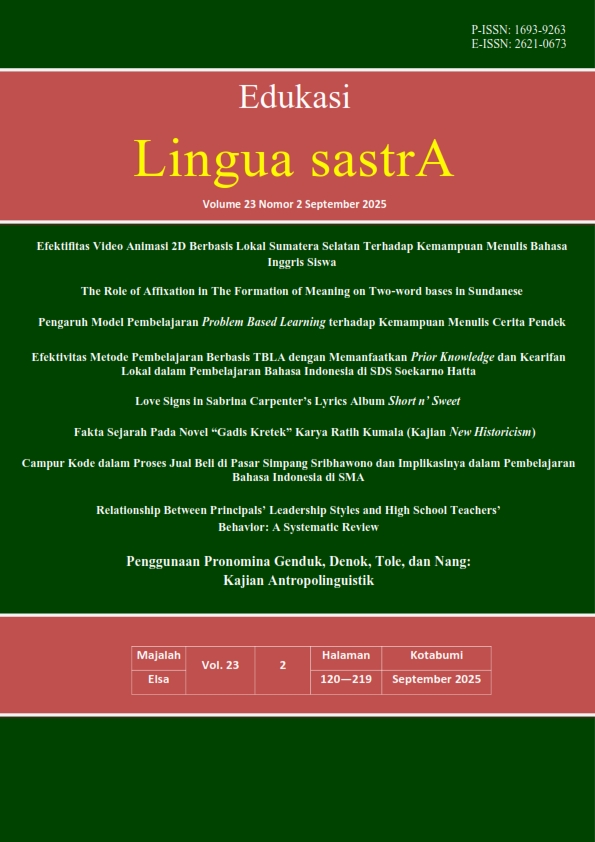
Penggunaan Pronomina Genduk, Denok, Tole, dan Nang: Kajian Antropolinguistik
Abstract:
The use of the pronouns genduk, denok, tole, and nang among the Javanese people represents a way of using language that reflects social and cultural values. This study aims to explain the use of these pronouns based on gender and social contexts, as well as to understand their meanings. The data were obtained from five informants of Javanese ethnicity, aged between 21 and 60 years, representing various generations. This research is of a qualitative descriptive type. The methods of observation and conversation were used during the data collection process. The observation techniques included note-taking, audio recording, and participatory observation (conversing while listening). The conversational techniques involved face-to-face and non-face-to-face interviews. A comparative technique (HBB) was employed to evaluate the data using an extralingual equivalence method. Based on the research findings, the pronouns genduk and denok are used for girls and signify intimacy, affection, and social norms influenced by social context and dialect. For boys, the pronouns tole and nang are used to indicate gender identification, emotional closeness, and age hierarchy. All of these pronouns serve as cultural markers that influence attitudes and social interactions within Javanese society, as well as function as useful communication tools. The Sapir–Whorf theory, which emphasizes the reciprocal relationship between language, culture, and thought, aligns with these observations. Therefore, through the use of the pronouns genduk, denok, tole, and nang, the sociocultural processes of Javanese culture and the preservation of traditional values within the community are reflected
Downloads

This work is licensed under a Creative Commons Attribution-NonCommercial 4.0 International License.