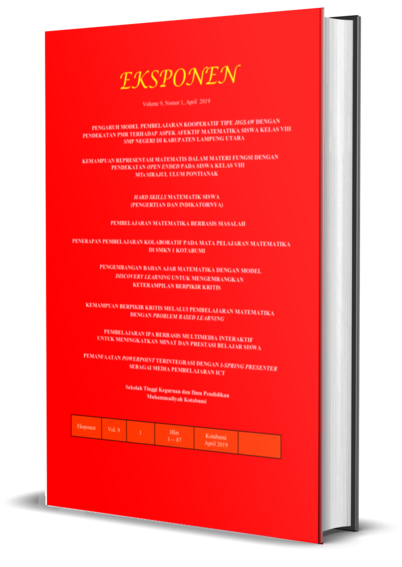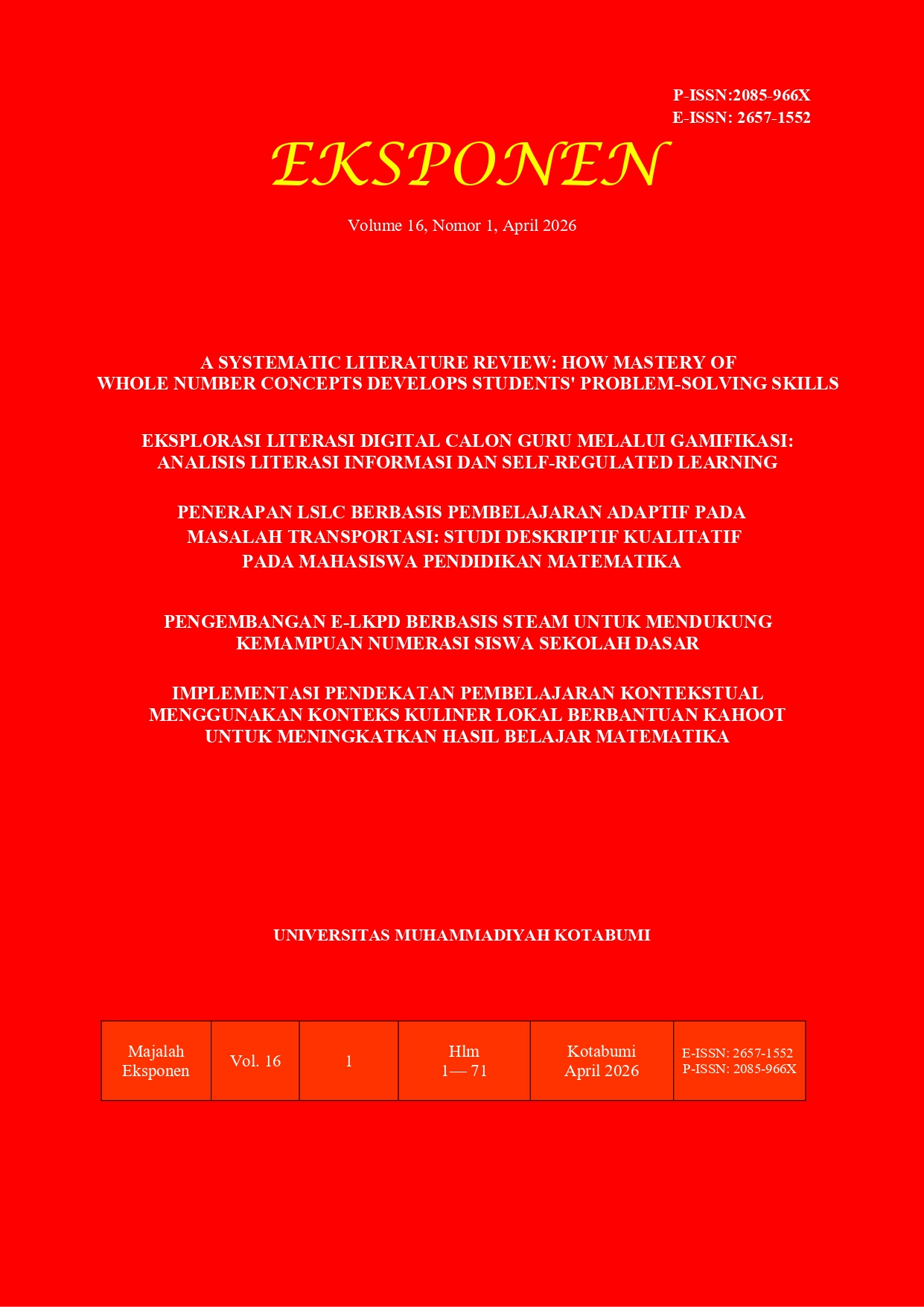
Eksponen (P-ISSN: 2085-966X and E-ISSN: 2657-1552) has been published since 2017 by Sentra Kekayaan Intelektual in collaboration with LPPM, Muhammadiyah University, Kotabumi. The journal has regularly published two times a year in April and September. This journal publishes original papers researching that focus on education and mathematic. The editorial team has the right to edit every submitted manuscript without changing the substance of the article. Posts that are not published can be requested back.
ISSN
2085-966X (printed) |
2657-1552 (online)
Published
2026-05-05
Accreditation

Articles
A Systematic Literature Review: How Mastery of Whole Number Concepts Develops Students' Problem-Solving Skills
Conceptual difficulties and visual representation barriers are often major challenges in learning integers, especially related to understanding negative numbers and mathematical operations such as addition and subtraction. This study aims to identify the problems faced by students in learning integers, evaluate the effectiveness of various teaching methods, and propose innovative approaches to improve students' understanding. The methodology used is a systematic review based on Systematic Literature Review (SLR), by analyzing relevant research articles using PRISMA guidelines. This study examines various learning strategies, such as the use of realistic contexts, innovative visual models, manipulatives, and interactive technology. The results showed that a real-world context- based approach and the use of visual models can significantly improve students' understanding compared to conventional methods. Students who engaged in manipulative-based learning and class discussions also showed better mathematical thinking flexibility. These findings highlight the need for further exploration of the use of real contexts, more innovative visual models, and the application of gamification technology in integer learning. In conclusion, integer learning requires a more innovative approach by integrating realistic contexts, new visual models, and interactive technology. This not only increases student engagement but also supports the development of conceptual and procedural abilities more effectively.
 Google Scholar
 Garuda
 Sinta
Sinta
Pages: 1-18
63 views | 59 downloads
Statistics and Citations
Eksplorasi Literasi Digital Calon Guru Sekolah Dasar melalui Gamifikasi: Analisis Literasi Informasi dan Self-Regulated Learning
Penelitian ini bertujuan untuk menganalisis peran gamifikasi sebagai katalisator Self-Regulated Learning (SRL) dan mengeksplorasi dinamika literasi informasi pada mahasiswa calon guru sekolah dasar. Menggunakan desain deskriptif eksploratif, studi rintisan ini melibatkan 56 partisipan melalui voluntary response sampling. Data dikumpulkan menggunakan kuesioner daring (Cronbach's Alpha = 0.808) dan dianalisis melalui statistik deskriptif serta korelasi Pearson menggunakan IBM SPSS 26. Hasil penelitian menunjukkan korelasi positif yang sangat kuat (r = 0.749, p < 0.01) antara persepsi tantangan dalam gim dengan dorongan mencari informasi lanjutan, yang berhasil memicu 82,1% mahasiswa menerapkan strategi SRL. Disimpulkan bahwa integrasi pembelajaran berbasis gim secara efektif menstimulasi aktivasi kognitif mahasiswa dari konsumen teknologi pasif menjadi pencari pengetahuan aktif. Studi ini merekomendasikan penerapan pedagogi digital berbasis inkuiri tergamifikasi, di mana dosen secara spesifik merancang elemen tantangan bertingkat (leveling challenge) yang memaksa mahasiswa melakukan validasi sumber eksternal untuk memecahkan masalah dalam gim.
Penerapan LSLC Berbasis Pembelajaran Adaptif Pada Masalah Transportasi: Studi Deskriptif Kualitatif Pada Mahasiswa Pendidikan Matematika
The Linear Programming course, specifically the Transportation Problem topic, is often considered difficult by mathematics education students due to the dense mathematical modeling and procedural algorithms that trigger learning anxiety. This research is driven by the need to address passive classroom dynamics and student heterogeneity through adaptive learning, a method whose implementation is challenging for a lecturer to do alone. This study aims to describe the dynamics of implementing Lesson Study for Learning Community (LSLC) based on an adaptive learning approach to the linear programming transportation problem. A qualitative descriptive methodology was used to capture critical moments in the classroom, dissect thinking obstacles, and document lecturer collaboration. This study focuses on in-depth qualitative observation through data reduction, data display, and triangulation. The findings show that the Plan stage successfully designed an adaptive learning path that integrates sharing tasks (Northwest Corner method) and jumping tasks (VAM with dummy). During the Do stage, this approach effectively activated a caring community, namely refutation followed by constructive feedback. Additionally, students cross-checked directly with the model lecturer to visualize the distribution route flowchart to resolve their bottlenecks. The See stage confirmed that this intervention triggered the active participation of passive students, and identified that minor computational errors were caused by inaccuracies in reading demand capacities. In conclusion, the integration of LSLC and adaptive learning provides an optimal evidence-based ecosystem to accommodate diverse student learning rhythms while continuously improving the quality of mathematics learning
Pages: 28-39
47 views | 49 downloads
Statistics and Citations
Pengembangan E-LKPD Berbasis STEAM untuk Mendukung Kemampuan Numerasi Siswa Sekolah Dasar
Numeracy learning in elementary schools still faces various challenges, particularly students’ low ability to understand contextual problems and analyze data. This study aims to develop a STEAM-based e-LKPD that is valid, practical, and effective in improving students’ numeracy skills. The method used is Research and Development with the ADDIE model, which consists of analyze, design, development, implementation, and evaluation stages. The research subjects were fifth-grade elementary school students. The instruments included expert validation sheets, response questionnaires, and numeracy tests. The results showed that the e-LKPD achieved a very valid category from material, media, and language experts. In the implementation stage, the e-LKPD was categorized as very practical based on student and teacher responses. Furthermore, the effectiveness test indicated that the e-LKPD significantly improved students’ numeracy skills. The discussion revealed that the integration of STEAM in the e-LKPD created contextual, interactive, and meaningful learning experiences. Therefore, the STEAM-based e-LKPD can serve as an innovative solution to enhance numeracy skills in elementary school students.
Implementasi Pendekatan Pembelajaran Kontekstual Menggunakan Konteks Kuliner Lokal Berbantuan Kahoot Untuk Meningkatkan Hasil Belajar Matematika
Pecahan merupakan salah satu materi matematika yang kerap menimbulkan miskonsepsi pada siswa, baik dalam memahami konsep, menerapkan prosedur operasi, maupun melakukan perhitungan. Penelitian ini bertujuan untuk menganalisis peningkatan hasil belajar matematika siswa melalui penerapan pendekatan pembelajaran kontekstual dengan memanfaatkan konteks kuliner lokal Kota Lubuklinggau berbantuan media Kahoot. Pemilihan topik ini didasarkan pada temuan awal yang menunjukkan bahwa siswa masih mengalami kesulitan dalam memahami pecahan senilai, membandingkan pecahan, dan menyederhanakan pecahan karena pembelajaran belum sepenuhnya dikaitkan dengan representasi konkret dan pengalaman sehari-hari siswa. Penelitian ini dilaksanakan pada 23 siswa kelas IV melalui tahapan pra siklus, Siklus I, dan Siklus II, yang mencakup perencanaan, pelaksanaan tindakan, observasi, dan refleksi. Data diperoleh melalui tes hasil belajar, observasi aktivitas guru dan siswa, wawancara dan dokumentasi. Hasil penelitian menunjukkan adanya peningkatan ketuntasan belajar dari 13% pada pra siklus menjadi 61% pada Siklus I, kemudian meningkat menjadi 87% pada Siklus II. Nilai rata-rata kelas juga meningkat dari 60,21 menjadi 71,96 dan mencapai 80,43. Aktivitas siswa mengalami peningkatan dari 47% pada pra siklus menjadi 66% pada Siklus I dan 93% pada Siklus II. Temuan ini menunjukkan bahwa pembelajaran kontekstual berbantuan Kahoot dengan konteks kuliner lokal dapat membantu siswa memahami konsep pecahan secara lebih rill, interaktif, dan bermakna. Penelitian ini memberikan kontribusi terhadap penguatan strategi pembelajaran kontekstual berbasis budaya lokal serta pemanfaatan teknologi digital dalam pembelajaran di sekolah dasar.
Lucy Asri Purwasi,
As Elly,
Auliyah,
Evanni Daniswara Haryono,
Okta Selvia,
Silvia Putri,
Efin Vanalepi,
Vivi Sakta Tri Rahmadona
Pages: 56-71
64 views | 40 downloads
Statistics and Citations
Indexer Sites